Introduction to Electricity
Core Concepts for IT Professionals
An introduction to the fundamental principles of electricity, including Voltage, Current, Resistance, Ohm’s Law, and the difference between AC and DC power.
1 Purpose
This document introduces the fundamental principles of electricity that are essential for any IT hardware technician. Understanding these core concepts is the first step toward being able to diagnose and troubleshoot power-related issues in computer systems.
2 What You’ll Learn
By the end of this reading, you will be able to:
- Define Voltage, Current, and Resistance.
- Apply Ohm’s Law to solve for a missing value in a simple circuit.
- Differentiate between AC (Alternating Current) and DC (Direct Current).
- Identify the schematic symbols for basic electronic components.
NoteLearning Outcomes
This reading maps to the following program and course learning outcomes:
- Program Learning Outcomes (PLOs):
- 3. Apply terminology and numeric or system concepts: This document introduces the fundamental terminology and mathematical relationships (Ohm’s Law) governing electricity.
- Course Learning Outcomes (CLOs):
- 1. Identify hardware and basic network components: This reading explains the basic electrical properties that all hardware components depend on.
- 3. Troubleshoot hardware and basic network components: A foundational understanding of electricity is the starting point for all power-related troubleshooting.
TipLearning Objectives, KSAs, and Technologies
This exercise will help you develop the following skills and knowledge, which align with the O*NET SOC Code 15-1232.00 for Computer User Support Specialists.
| Learning Objective | O*NET KSAs | Technologies Used |
|---|---|---|
| Define Voltage, Current, and Resistance. | Knowledge: Computers & Electronics, Physics Skills: Reading Comprehension |
N/A (Conceptual) |
| Apply Ohm’s Law to simple problems. | Knowledge: Computers & Electronics Abilities: Mathematical Reasoning, Information Ordering |
N/A (Conceptual) |
3 The Fundamentals of Electricity
At its most basic level, electricity is the flow of electrons. For an IT technician, understanding three key concepts—Voltage, Current, and Resistance—is essential for diagnosing power issues. A common and helpful analogy is to think of electricity flowing through a wire like water flowing through a pipe.
ImportantSafety First
Working with electricity can be dangerous. The AC power from a wall outlet can be lethal. Always assume a circuit is live until you have verified it is de-energized. Never work on internal computer components while they are plugged into a power source.
3.1 Core Concepts
Voltage (V): Measured in Volts. This is the electrical potential difference between two points. In our water analogy, voltage is the water pressure. A higher pressure allows more water to flow.
Current (I): Measured in Amperes (Amps). This is the rate at which charge is flowing. In our analogy, current is the flow rate or volume of water moving through the pipe.
Resistance (R): Measured in Ohms (Ω). This is the opposition to the flow of current. In our analogy, resistance is a narrowing or obstruction in the pipe that restricts water flow.
3.2 Ohm’s Law
These three concepts are related by a fundamental principle called Ohm’s Law. It states that the voltage across a conductor is directly proportional to the current flowing through it, provided all physical conditions and temperatures remain the same.
The formula is:
\[ V = I \times R \]
Where: - V = Voltage - I = Current - R = Resistance
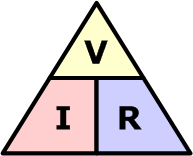
You can rearrange this formula to solve for any of the variables. For example, if you know the voltage and resistance, you can calculate the current: I = V / R.
The diagram in Figure 1 visualizes the relationship between voltage, current, and resistance, giving you a quick reminder of which math operation to use when solving for each quantity.
3.3 AC vs. DC Power
- Alternating Current (AC): The direction of current flow reverses periodically. This is the type of power delivered by utility companies to homes and businesses (e.g., 120V AC in the US). It is efficient for long-distance transmission. The animation below visualizes this alternating pattern.
NoteUnderstanding Peak vs. RMS Voltage
You might be wondering why the animation shows a peak voltage of 170V when we talk about 120V AC power in the United States. This is because the 120V is the RMS (Root Mean Square) voltage, which is a kind of average value used for calculating power.
Peak Voltage (Vp): The actual maximum voltage reached by the sine wave, which is about 170V.
RMS Voltage (Vrms): The effective voltage, which is equivalent to the DC voltage that would provide the same amount of power. For a sine wave, the relationship is:
\(V_{rms} = \frac{V_p}{\sqrt{2}}\)
Most standard multimeters measure RMS voltage, which is the most common and useful value for power calculations. However, it’s important to remember that the actual voltage is swinging much higher, to the peak value, during each cycle.
- Direct Current (DC): The current flows in only one direction. This is the type of power used by almost all electronic components inside a computer. A computer’s power supply is responsible for converting the AC power from the wall into the various DC voltages needed by the motherboard, CPU, and other parts (e.g., +12V, +5V, +3.3V).
3.4 Basic Components and Symbols
When reading circuit diagrams (schematics), you will encounter standard symbols for different components.
| Component | Symbol | Purpose |
|---|---|---|
| Resistor |  |
To impede the flow of current. |
| Capacitor | 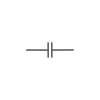 |
To store electrical energy in an electric field. |
| Inductor | 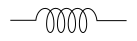 |
To store energy in a magnetic field (a coil). |
| Switch | 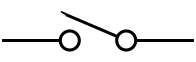 |
To interrupt or complete a circuit path. |
| Ground |  |
A common return path for electric current. |
4 Reflect and Review
ImportantReflection: 3-2-1
Now that you have reviewed this document, take a moment to reflect on your learning. In your Microsoft Teams Student Notebook, create a new page for this topic and write down the following:
- 3 core concepts of electricity.
- 2 differences between AC and DC power.
- 1 question you still have about Ohm’s Law.
This reflection is for your instructor to review and helps solidify your understanding of the concepts.
TipCheck on Learning
Test your understanding with the following questions. These questions provide retrieval practice and reinforce key concepts covered in this reading. In your Microsoft Teams Student Notebook, answer the following:
- Using the water pipe analogy, what do voltage, current, and resistance represent?
- A component has a resistance of 3 Ohms and the voltage across it is 12V. How much current is flowing through it?
- What type of power comes out of a standard US wall outlet?
- What is the primary function of a computer’s power supply?