Intro to the Central Processing Unit
Hardware and Architecture
1 The CPU
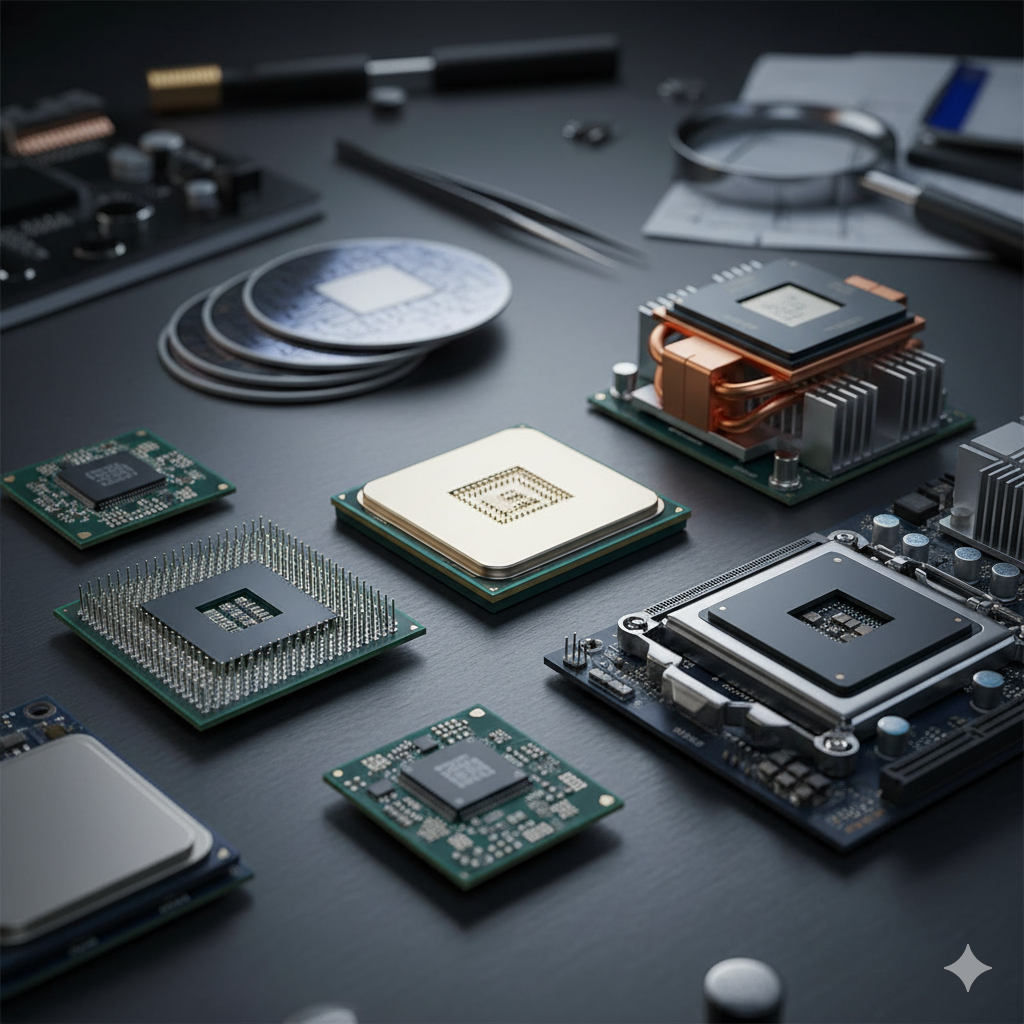
The Central Processing Unit (CPU) is the brain of a computer, responsible for executing instructions, performing calculations, and managing the flow of data throughout the system. It interprets software commands and coordinates hardware resources, making it a critical component in every computing device.
Below is an introduction to many aspects of a CPU, each deserving a deep a look in their own right. After reading about the different aspects of CPU’s, continue on to more comprehensive instruction on different types of processors, processor architectures, and manufacturing techniques.
1.1 Processor Types
Processors are designed for different applications and environments. Understanding these categories helps technicians select the right CPU for a given system.
Desktop Processors
Desktop CPUs, such as Intel Core and AMD Ryzen, are optimized for performance and versatility in personal computers. They typically offer multiple cores, high clock speeds, and support for discrete graphics cards.
Mobile Processors
Mobile CPUs are found in laptops, tablets, and smartphones. They prioritize power efficiency and thermal management, often integrating graphics and connectivity features. Examples include Intel Core U-series, AMD Ryzen Mobile, Apple M-series, and ARM-based chips from Broadcom.
Server Processors
Server CPUs, like Intel Xeon and AMD EPYC, are built for reliability, scalability, and handling heavy workloads. They support advanced features such as error-correcting code (ECC) memory, large cache sizes, and multi-socket configurations.
Embedded and SoC (System on a Chip)
SoC processors integrate CPU, GPU, memory, and I/O controllers onto a single chip, reducing size and power consumption. They are common in smartphones, IoT devices, networking equipment, and single-board computers (e.g., Broadcom chips in Raspberry Pi).
Workstation and High-Performance Processors
Workstation CPUs, such as AMD Threadripper and Intel Xeon W, are designed for demanding tasks like video editing, 3D rendering, and scientific computing. They offer high core counts and advanced memory support.
1.2 CPU Architecture
Modern CPUs are built using complex microarchitectures that define how internal components like cores, cache, and execution units are organized and interact. Architectural choices impact performance, power efficiency, and feature sets.
Author: Tech in a Teacup | View Channel
From Von Neumann and Harvard models to CISC vs RISC, EPIC (Itanium), superscalar processors, multi-core and many-core CPUs, and hybrid architectures like ARM big.LITTLE and Apple Silicon.
1.3 Instruction Set Architecture (ISA)
An ISA specifies the set of instructions a CPU can execute and how software communicates with hardware.
CISC (Complex Instruction Set Computing): Used by Intel and AMD x86 processors, offering a rich set of instructions for complex operations.
RISC (Reduced Instruction Set Computing): Used by ARM-based processors (Apple, Broadcom), focusing on simpler instructions for faster execution and lower power consumption.
1.4 Silicon Wafer Manufacturing
CPUs are manufactured on silicon wafers using advanced photolithography techniques. Each wafer contains hundreds or thousands of chips, which are cut, tested for defects, and packaged for use in computers and devices.
Author: Branch Education | View Channel
Take a tour of a microchip fabrication plant or fab and walk you through the dozens of steps used to make a microchip.
1.5 Package and Pin Types
CPUs are available in several package types, which determine how they connect to the motherboard: - LGA (Land Grid Array): Used by Intel, with contact pads on the CPU and pins in the socket. - PGA (Pin Grid Array): Used by AMD, with pins on the CPU that fit into socket holes. - BGA (Ball Grid Array): Used in embedded systems and Apple chips, with solder balls that are permanently attached to the board.
1.6 Internal Components
Registers
Registers are small, fast storage locations inside the CPU that temporarily hold data and instructions during processing.
Cache
CPUs use hierarchical cache memory (L1, L2, L3) to store frequently accessed data, reducing the time needed to fetch information from main memory.
Cores and Threads
- Core: An independent processing unit within the CPU, capable of executing instructions.
- Thread: A sequence of instructions that can be processed by a core. CPUs with simultaneous multithreading (SMT) can run multiple threads per core, improving efficiency.
Arithmetic Logic Unit (ALU)
The ALU performs mathematical calculations and logical operations, serving as the computational engine of the CPU.
Author: Branch Education | View Channel
Dive into the nanoscopic world of transistors. See how an individual transistor works, then how they are connected together and organized into logic gates.
1.7 Communication with the PCH
The Platform Controller Hub (PCH) manages input/output functions such as USB, SATA, and networking. The CPU communicates with the PCH using high-speed interfaces like DMI (Direct Media Interface), ensuring efficient data transfer between system components.
1.8 Von Neumann Architecture and the Fetch-Execute Cycle
Most modern CPUs are based on the Von Neumann architecture, which describes a computer design where program instructions and data share the same memory and pathways. This architecture simplifies hardware design and enables flexible, programmable systems.
A key concept in Von Neumann architecture is the fetch-execute cycle (also called the instruction cycle). This cycle is the fundamental process by which a CPU operates:
- Fetch: The CPU retrieves an instruction from memory, using the program counter to keep track of where it is in the program.
- Decode: The instruction is interpreted by the control unit, determining what actions are required.
- Execute: The CPU carries out the instruction, which may involve arithmetic operations, moving data, or interacting with hardware.
- Store: Results are written back to registers or memory if needed.
This cycle repeats continuously while the computer is running, allowing the CPU to process instructions and manage system operations. Understanding the fetch-execute cycle is essential for grasping how CPUs work at a fundamental level. More detailed coverage of Von Neumann architecture and the instruction cycle will be provided in a dedicated article.
Author: Computer Science Lessons | View Channel
Dive into the nanoscopic world of transistors. See how an individual transistor works, then how they are connected together and organized into logic gates.
This article introduces the foundational concepts of CPUs. Future articles will explore topics such as overclocking, thermal design, CPU benchmarking, and advanced microarchitecture in greater detail.